

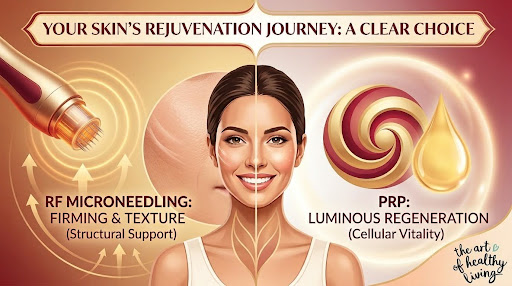
RF microneedling and PRP (the ‘vampire facial’) both stimulate collagen, but they work through very different mechanisms and are suitable for different problems. RF microneedling uses radiofrequency heat to tighten and lift sagging skin, while PRP uses your own blood growth factors to heal, brighten and regenerate. The best choice depends on whether your main goal is firmness or overall skin quality.
You’ve done the research. You’ve scrolled through Reddit threads and Instagram before-and-afters until your eyes glazed over. Two treatments continue to appear: RF microneedling and PRP. Both promise younger-looking skin. Both involve needles (sorry). And both have passionate fans who insist theirs is the superior option.
So which one actually makes sense for your skin?
If you’ve already looked at the most effective anti-aging treatments available today, you’ve probably noticed how many options exist. That’s part of the problem. The sheer number of choices makes it harder to figure out what’s really good for you, versus what’s just well-marketed. The thing is: RF microneedling and PRP really do different things. The question “what is better?” is a bit like asking whether a hammer or a screwdriver is the better tool. Depends entirely on the job.
What actually happens during each treatment
RF microneedling: heat and needles, working together
RF microneedling couples small insulated needles with radio frequency energy. The needles penetrate the skin to a controlled depth, usually between 0.5 and 4.5 mm, depending on the treatment area and the device used. At the tip of each needle, RF energy heats the deep dermis to approximately 65 to 70°C, and that controlled heat initiates a wound healing response.
What makes this different from standard microneedling is the thermal element. The heat triggers fibroblast activity and stimulates the production of collagen, elastin and hyaluronic acid. Not just any of those. All three. A 2025 study published in Scientific Reports found that RF microneedling significantly reduced the number of senescent (aging) fibroblasts in the skin compared to standard microneedling alone, while simultaneously increasing collagen and elastin levels. That is a meaningful distinction.
Several devices fall under the umbrella of RF microneedling: Morpheus8, Secret RF, Vivace and Profound. Profound RF is notable because it is the only device with FDA clearance for stimulating all three structural proteins simultaneously. Most RF microneedling protocols require one to three sessions, with results gradually increasing over three to six months as your body does the actual remodeling work.
PRP: the repair kit for your blood
PRP stands for platelet-rich plasma, and that’s exactly what it sounds like. A small amount of your blood is taken and then spun in a centrifuge to concentrate the platelets. Those platelets are packed with growth factors, the proteins that your body naturally uses to repair tissue.
The concentrated plasma is injected directly into the skin or applied locally immediately after a microneedling session. That second option is the “vampire facial” you’ve been seeing everywhere. According to the Cleveland ClinicPRP contains growth factors that support wound healing and tissue regeneration, and its use in cosmetic skin treatments has steadily increased since the 2010s.
PRP is particularly strong for improving appearance, evening skin tone, treating mild scars and rejuvenating sensitive areas such as under the eyes. Because it is extracted from your own blood, there is virtually no risk of an allergic reaction. You will normally need three to four sessions approximately four to six weeks apart.
So which one is better for your skin?
That depends on what’s really bothering you.
If sagging or laxity is the main problem – RF microneedling has a clear advantage. The thermal energy contracts existing collagen fibers and stimulates the production of new collagen and elastin at a deeper level than PRP can achieve. This makes a real difference on the jawline, lower face and neck, the areas where gravity is first visible. PRP simply does not deliver thermal energy to the dermis, meaning it cannot achieve the same degree of tightening.
If your skin looks tired, uneven or shows minor scarring – PRP in combination with microneedling is worth serious consideration. The growth factors accelerate cell repair and renewal, which translates into brighter, smoother skin after a series of treatments. It is especially effective for post-inflammatory pigmentation and superficial acne scars. The American Academy of Dermatology notes this that combining PRP with microneedling can lead to less visible scars compared to microneedling alone.
And if you want tighter and more radiant – Some clinics offer both treatments in the same session. This isn’t just marketing fluff; there is clinical evidence behind it. A 2024 clinical trial A study of neck wrinkle treatments found that combining radiofrequency with PRP produced significantly better skin elasticity and collagen results after six months compared to PRP injections alone or microneedling with PRP alone. The combination group also held up better over time.
What the results actually look like
Neither treatment produces results overnight. I just want to make that expectation clear.
With PRP you often notice a shine within a few days. Your skin looks a little fuller and more vibrant. But the real texture and tone improvements build over several weeks and multiple sessions. It’s a slow burn.
RF microneedling works on a longer timeline. Early tightening may become visible after four to six weeks, but the full effect does not occur for three to six months. That’s because collagen remodeling is a gradual biological process, not a switch you flip.
One step that doesn’t get enough attention: Before committing to either treatment, be sure to review actual patient photos of the specific device and clinic you are considering. No stock photos. Unfiltered social media posts. Real before and after images of the provider you plan to see. Especially for RF microneedling in-depth RF skin tightening before and after photos can give you a much clearer picture of the kind of contouring and tightening this technology produces in real patients. Different devices and different providers produce different results, so seeing evidence of your actual treatment option is more important than reading averages.
Downtime, costs and practical matters
These details are often the deciding factor, so I’ll be clear.
PRP microneedling is associated with approximately one to two days of redness. Most people like to apply makeup the next day. It’s a pretty simple recovery. RF microneedling demands more from you. Expect redness and mild swelling for two to five days, with possible bruising. If you’re looking specifically at Profound RF, plan on about five to seven days of social downtime. It’s not exactly painful, but you don’t want to plan a big event the following week.
As for the session, PRP typically requires three to four treatments for optimal results. RF microneedling often requires less, sometimes only one, session with Profound RF. That’s important when you take time and planning into account.
Costs are more difficult to determine because they vary by location and provider, but in general PRP microneedling is cheaper per session. RF microneedling costs more upfront, but the fact that you may need fewer sessions can offset the situation. Both treatments use anesthetic cream; RF can be a little more uncomfortable due to the heat. Deep RF is usually performed under local anesthesia, which makes a big difference. To be honest, I put off seeking needle treatments for a long time because I assumed they would be unbearable. The anesthesia really helps. The expectation was worse than the actual experience.
A few things to consider before booking
The provider’s login details are more important here than you might think. The AAD recommends consulting a doctor with expertise in cosmetic skin treatmentsand that advice is solid. Both RF microneedling and PRP require skills to work safely and effectively, and the quality of your results depends heavily on who performs the treatment and what equipment they use.
Both treatments are generally safe for all skin tones, but proper device settings and provider experience are critical, especially for deeper skin tones where incorrect settings can cause hyperpigmentation. Ask questions. A good provider will welcome them.
And please, skip the microneedling rollers at home. The AAD has specifically flagged at-home microneedling as risky due to infection and technique issues. Professional treatments work at depths and energy levels that consumer devices simply cannot safely reproduce.
If you have active breakouts, eczema or any other form of skin infection, you should wait until everything is better before booking a treatment. That is non-negotiable. One more thing: not all RF microneedling devices are created equal. The technology, needle configuration and energy delivery vary by brand. Ask your provider which device they use and why they chose it.
Choose what is right for you
Neither treatment wins across the board. They solve different problems. The smartest move is to be honest about what your skin actually needs. Is sturdiness the priority? RF microneedling is hard to beat. Are you looking for better texture, brighter tone or faster healing? PRP has a strong track record there. Some people do both, spread out or combined. That’s also a perfectly reasonable approach.
The key is tailoring treatment to the goal, not the trend.
If you’re thinking about how skin treatments fit into a broader approach to self-care, The Art of Healthy Living has a helpful piece on maintaining wellness in your beauty routine that connects some of these dots. Worth a read if you’re still developing your plan.