

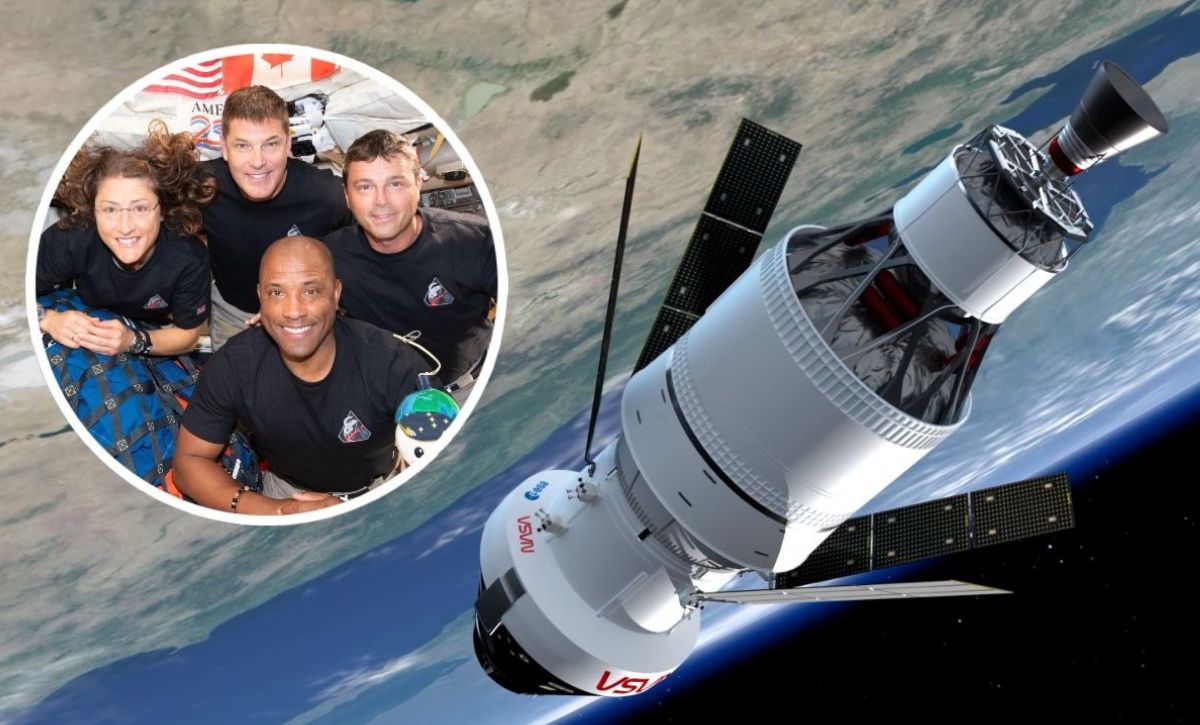
Tonight, the first astronauts to orbit the moon in more than 50 years are coming home. And if you’re on the California coast, you might be able to experience the history firsthand.
The four-person crew of the Orion spacecraft – the first astronauts to orbit the moon in more than 50 years – will splash down off the coast of San Diego on April 10 at 8:00 PM EDT / 5:07 PM PDT.
After ten extraordinary days in space, including a moon flight that broke all human distance records in history, Commander Reid Wiseman, Pilot Victor Glover, Mission Specialist Christina Koch and Canadian Space Agency astronaut Jeremy Hansen are finally coming home – and they’re landing right in our backyard.
What happens and when
Here is the sequence of events leading to the landing: At 6:33 PM PDT, the crew module separates from the service module. At 6:53 PM PDT, the capsule will enter the atmosphere – and for about six minutes, all crew communications will go dark as extreme heat creates a plasma layer around the capsule. Eleven parachutes are then deployed in succession, slowing the capsule from almost 40,000 km/h to just 32 km/h for a soft landing in the Pacific Ocean.
The Splashdown is scheduled for approximately 8:07 PM ET – about 60 miles from San Diego – weather permitting.
Then, within two hours of landing, the crew will be flown by helicopter to the USS John P. Murtha, undergo medical checks and then travel back to NASA’s Johnson Space Center in Houston.
Can you see it from the coast?
The honest answer: probably not right away, but don’t let that stop you from trying.
Francisco Contreras, an Oceanside resident and board member of the San Diego Astronomy Association, told CBS 8, “I’m going to give it a try. I’d say go to the coast. Since it’s so high and so far away, you should be able to see it from the coast; you don’t have to get close to San Clemente, I don’t think. As long as you have a clear view of the northwest, that would be your best chance.”
Your best viewing spots along the Southern California coast are any beach with an unobstructed northwest horizon: Oceanside, Carlsbad, Del Mar, Ocean Beach, or Point Loma. Around 5:00 PM PDT, look northwest toward the horizon for what could be a bright streak of light across the sky as the capsule reenters the atmosphere.
View parties and events in San Diego
If you’d rather guarantee you don’t miss a second of it, San Diego has you covered.
The San Diego Air and Space Museum is hosting an Artemis II Splashdown Family PJ Party on Friday at 4 p.m. Guests will watch the live broadcast of Orion’s return on a huge LED screen in the Pavilion of Flight. The event is included with general admission, and those arriving at 4:00 PM or later will receive half-price admission.
San Diego’s Fleet Science Center is also hosting ARTEMIS Week through Saturday – a series of temporary exhibitions and opportunities to connect with NASA experts and scientists in honor of the mission.
How to stream it live at home
You don’t have to leave your couch to witness history.
Netflix does streaming the entire splashdown will air live as part of NASA+ programming, with coverage starting at 3:30 PM PDT – no additional subscription required beyond your existing membership.
The broadcast will feature live commentary from the recovery team, USS Captain John P. Murtha and Navy divers on standby in the Pacific Ocean.
You can also stream live on NASA’s YouTube channel, NBC News NOW (free on any device), PBS NewsHour, and NASA.gov.
Why tonight is important
It is the first time since Apollo 17 in December 1972 that NASA and the Department of Defense have teamed up for the return of a lunar crew.
Everything about tonight – the Navy recovery operation, the parachute array, the heat shield – is a test run for the moon landings to follow. Artemis III will attempt to land astronauts on the moon’s south pole as early as next year.
Tonight at 5:07 PM, the Pacific Ocean near San Diego will be the center of the universe for just a few minutes.
Don’t miss it. 🌙
Sources: NASA, CBS 8 San Diego, FOX 5 San Diego, Netflix Tudum, Al Jazeera, Space.com, PBS NewsHour, San Diego Air and Space Museum – April 10, 2026