


Three shirts started all this. When Matthieu Blazy presented his debut collection for Chanel in October 2025, the pieces that sparked the most conversation weren’t the tweed suits or the evening looks. There were three oversized cotton button-down shirts made by France’s oldest shirtmaker, Charvet, each anchored at the hem with a Chanel chain, each made in collaboration with a 188-year-old Parisian shirtmaker that most of the audience had never heard of.
Nicole Kidman wore one. A$AP Rocky wore one. Jacob Elordi wore one. Jesse Buckley wore one. The shirts cost between 3,500 and 3,900 euros and are sold out. On Thursday, July 2, Chanel announced that it had purchased Charvet, the company that made them. Financial terms of the deal were not disclosed. What it does reveal is where Blazy is leading the way, what Chanel values in its portfolio and how a single shirt can redirect two institutions at once.
The house behind Charvet
Jozef-Christophe Charvet founded the house on rue de Richelieu in Paris in 1838, essentially inventing the dedicated shirt tailor. Before Charvet opened, shirts were made by linen suppliers from fabric brought in by the customer. Charvet changed that by creating a model in which the customer was measured, the fabric was selected from the house’s own collections and the garment was made on site.
The address is now Place Vendôme 28, where Charvet has been located since 1982. The house creates more than a thousand new fabric patterns every year. The third floor houses what is considered the world’s largest collection of shirts, with 6,000 varieties of poplins, batistes, zephyrs and voiles.
A special room contains nothing but collar options. Of the five most prominent French shirt makers of the twentieth century, Charvet is the only one still active. That’s no coincidence. It is the result of the fact that it is truly irreplaceable.
Customer history spans centuries. Marcel Proust, Winston Churchill, John F Kennedy, Yves Saint Laurent, Karl LagerfeldAnd Sofia Coppola all shopped there. American presidents, from Kennedy to Reagan, were regulars. The house does not aim for visibility. Visibility finds it.
How Blazy got there and what followed
This comes after artistic director Matthieu Blazy collaborated with the shirtmaker for his debut collection at Chanel. https://t.co/nZHm1CQmDw
— Vogue Runway (@VogueRunway) July 2, 2026
Blazy’s path to Charvet began with research into Gabriel Coco Chanel’s personal history. He found photos of her wearing men’s shirts that belonged to Arthur “Boy” Capel, her longtime lover, who was a devoted Charvet customer. She also used Charvet ties as belts in her costume design for the Ballets Russes in the 1920s. The connection had always been there. Blazy chose to follow it.
Producing the debut collaboration was not easy. About 60 people work in Charvet’s workshop in Saint-Gaultier. It does not have the capacity to fulfill large-scale orders on its own. A second manufacturer was brought in, who operated under Charvet’s direct supervision at every stage of production. The shirts reached the runway. They became the most talked about pieces of the season.
Blazy returned to Charvet for his 2027 cruise collection, incorporating a guipure lace front panel into the shirt construction. At that point, a permanent agreement had become the obvious next step for both sides.
Why the Chanel Charvet deal happened when it did
Anne-Marie And Jean-Claude Colbanthe siblings who have run Charvet since their father bought it in the 1960s are both in their 70s. The question of succession was not abstract. The knowledge available in-house is largely in the hands of specialists who cannot simply be replaced.
The Chanel acquisition solves that problem on terms that protect what makes Charvet worth protecting. Bruno Pavlovskywho takes over as president of Charvet while retaining his role as fashion president at Chanel, was direct about the scope of the plan. There will be no new locations. There will be no expansion. The only boutique on Place Vendôme remains exactly as it is. Chanel also acquires the six-story building itself.
Charvet joins an existing Chanel portfolio of artisan houses including cashmere specialist Barrie, milliner Maison Michel, silversmith Goossensand swimwear labels Eres and Orlebar Brown. The logic that connects them all is the same. These are homes whose value cannot be separated from their craft, and whose craft cannot survive without long-term financial obligations. Chanel’s 2024 sales were $18.7 billion. The takeover of Charvet is a small move financially. In cultural terms this is not the case.
What comes next for Chanel and Charvet
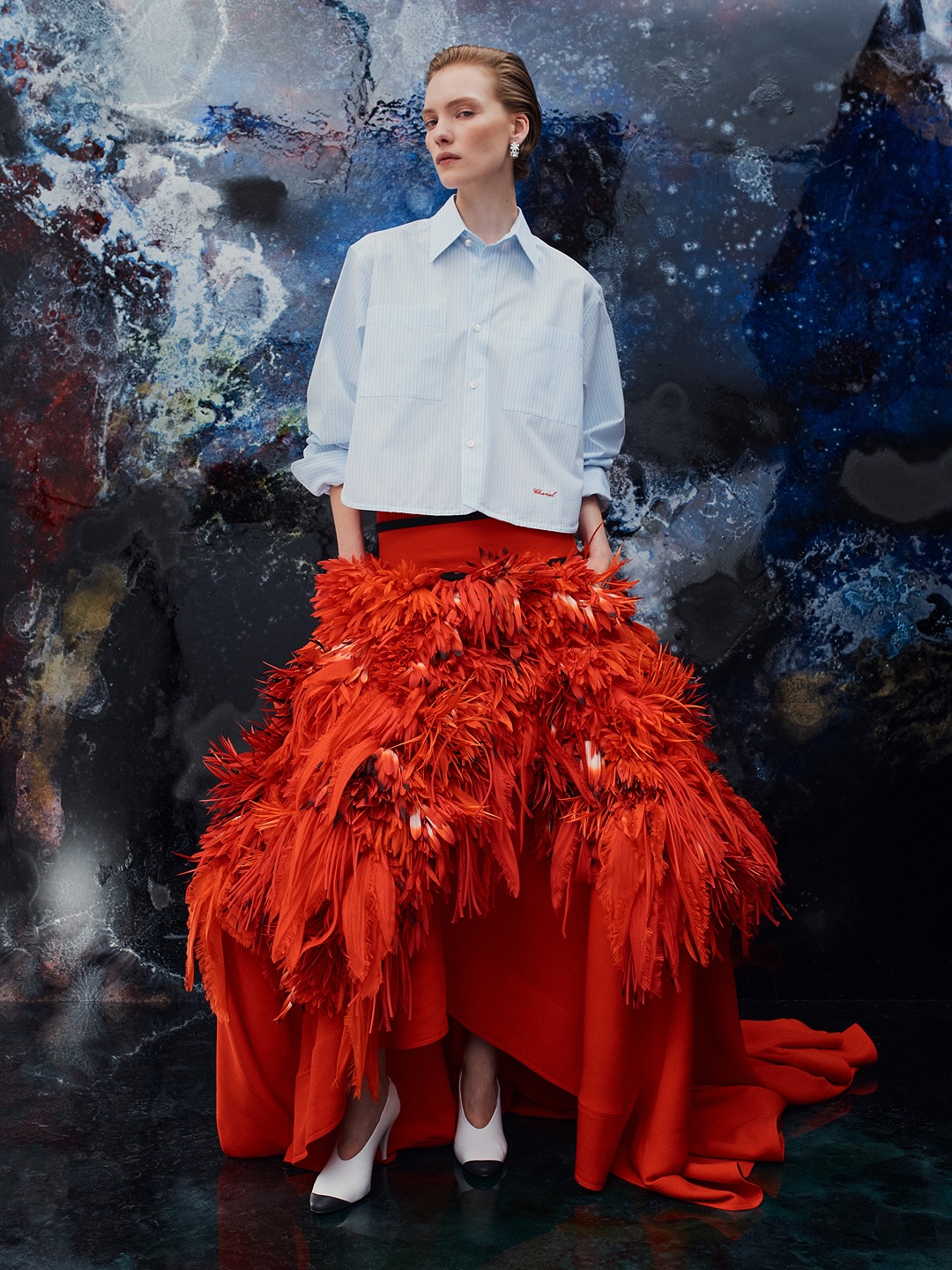
Blazy plans to continue collaborating with Charvet on future projects. The creative exchange that started with three shirts on a catwalk is now supported by institutional ownership. Pavlovsky called Charvet a treasure. The word was not random.
The announcement was deliberately timed ahead of Blazy’s second haute couture presentation, placing the acquisition within Chanel’s broader commitment to high-quality artisanal production. The parallel between Charvet’s tailoring and haute couture is precise. Both are models of fashion production in which the object takes precedence over the speed of its creation.
In 2026, that model is rare. Chanel decided it was worth protecting.
Featured image: Chanel