


The lace that whispers romance. The side that glides like liquid light. The shine of beads and sequins that catch every eye. These intricate details are what make a wedding dress unforgettable, and what makes preserving an embellished dress a delicate art. Preserving clothing is not just about keeping the fabric spotless; it’s about protecting every bead, crystal and thread that tells a story.
Although the ultimate goal is to clean the dress, the biggest risk often lies in mishandling the smallest details. Even methods marketed as “gentle” can ruin a heavily beaded masterpiece. True conservation requires precision – a localized, multi-step approach, carried out by experts who understand that such intricate beauty requires both science and patience.
The challenge of cleaning beaded wedding dress fabrics
#1. The risk of mechanical stress and abrasions
Beads, sequins and crystals are beautiful, but fragile. When handled roughly, two problems arise: the weight of the embellishments puts pressure on the delicate threads beneath them, and their hard edges can scratch or tear soft fabrics. Machine cleaning is particularly dangerous because it can crack plastic sequins, unravel threads, and leave permanent stains on silk or satin. For conservation specialists, minimizing mechanical stress is the number one rule when protecting ornaments.
#2. Why handicrafts are essential: Specialists clean individually
Because these gowns cannot withstand harsh motions or harsh chemicals, much of the cleaning process relies on precise, hands-on techniques.
Do specialists clean each bead or crystal individually? In fact, yes. High-quality preservation often involves micro-hand cleaning, especially in areas where oils and makeup build up, such as the neckline, cuffs and waist. Experts can use soft-bristled brushes or precision tools, such as micro-suction devices, to suck up residue without disturbing the intricate decorations.
It’s slow, painstaking work that feels more like restoration than simple cleaning. Each stroke is performed with surgical precision, ensuring that every bead remains luminous and every thread is secure. This practical care is the cornerstone of safe, effective preservation of beaded and crystal-embellished dresses.
Protecting integrity: Heat, chemicals and solvents
#1. The glue dilemma: How heat affects the retention of sequins on dresses
Modern gowns often rely on heat-sensitive adhesives to secure beads, sequins and crystals, which poses one of the biggest risks to home care. Can heat or harsh chemicals loosen this adhesive? Absolute. High temperature cleaning, steam, or aggressive pressing can melt or weaken the adhesive, causing entire sections of decorations to fall away.
Professionals can meet this challenge by using controlled techniques with little or no heat, in addition to carefully selected solvents that have been tested for compatibility with both the adhesive and the fabric. This intentional chemical attention ensures that the sparkle remains intact and ensures that sequins stay firmly in place on dress designs.
#2. Safe cleansing of crystals: The chemical compatibility test
Not all decorations react the same to cleaning products. Glass beads, acrylic crystals and plastic sequins all react differently to solvents, and some materials can cloud, discolor or even dissolve if mishandled.
To avoid disasters, experts always start with a chemical compatibility test before applying any cleaning solution. This gentle but essential step is the science behind safely storing crystals, ensuring that every bead, sequin and gemstone retains the clarity and sparkle it had on your wedding day.
The conservation hierarchy: Decorative protection during storage
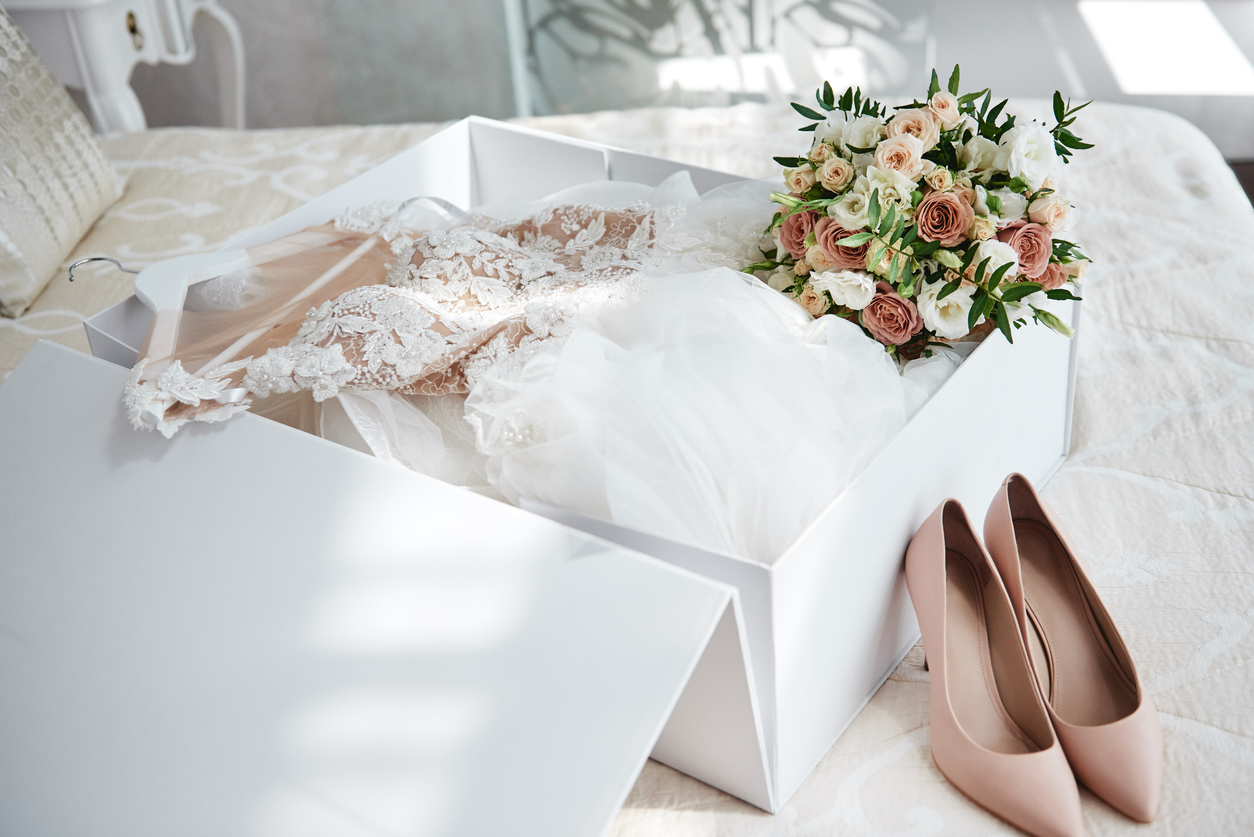
#1. Fine cleaning of jackets and structural support
Once a dress has undergone special cleaning, good support becomes essential before putting it away. Leaving a heavily beaded section folded on itself can lead to tension, wrinkling, or even breakage of the fabric over time. To prevent this, preservation experts use acid-free fabric or archival foam to support and separate the layers of the jacket.
These materials distribute weight evenly, protect delicate threads and maintain the integrity of heavy ornaments. It is this careful attention to structural support that separates a dress that merely survives from one that endures gracefully, preserving both beauty and craftsmanship for years to come.
#2. Final inspection and archive boxing
Before the gown is stored, it undergoes a careful final inspection. Every seam, thread and decoration is carefully examined for strength and stability, so that no detail is overlooked. Only after passing this rigorous assessment is the dress placed in an acid-free archival box – a home designed to preserve its splendor for decades.
With professional help, as offered at Clothing preservationyour dress is treated not just as fabric, but as a legacy: every sparkle, every stitch, every precious detail is honored and protected for generations to come.
Visual data reference
 Featured image: Fenton Roman/iStock
Follow us on Instagram for the latest news in fashion, lifestyle and culture @StyleRave_
—Read also