

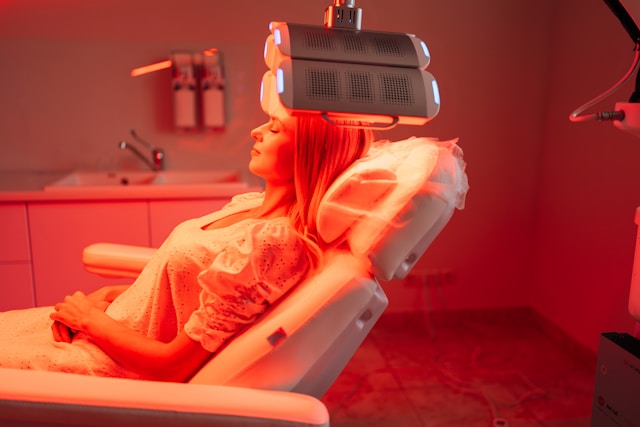
After a hair transplant, most people want to do everything they can to protect the result. That’s understandable. An operation takes time, money, patience and a lot of emotional energy. So when low-level laser therapy, also called LLLT or red light therapy, is suggested after a transplant, it may sound like the missing piece.
But is it really useful or just a new wellness trend? The answer lies somewhere in the middle. LLLT may support hair growth in selected people, especially those with pattern hair loss, but should be seen as a supplement rather than a guarantee.
What is LLLT?
Low-level laser therapy uses red or near-infrared light delivered through devices such as caps, helmets, combs or systems in the clinic. The idea is that light energy can influence cellular activity around hair follicles and help support the hair growth cycle. It is non-invasive and usually painless.
In hair care, LLLT is most often discussed for androgenetic alopecia, or pattern hair loss. Some people use it before surgery to support existing hair. Others use it after surgery as part of a broader maintenance plan. The important phrase is ‘part of a plan’.
What it can realistically do
When used consistently over time, LLLT can help improve hair density or thickness in some patients. It can also support existing miniaturized hair, which is important because a transplant only moves hair to selected areas. It does not prevent untreated natural hair from thinning in the future.
After a transplant, LLLT is sometimes suggested to support the recovery of the scalp and surrounding non-transplanted hair. However, it does not replace surgical skills, graft handling, medical therapy, nutrition or aftercare. It also does not make poorly placed grafts look natural.
The hype problem
The biggest problem with LLLT is not the therapy itself. It’s the way it’s marketed. Some ads make it look effortless: wear a device, regrow hair, reverse thinning, and secure the outcome of your transplant. Real life is less dramatic. Results take months, require consistency and vary from person to person.
The quality of the device also varies. Wavelength, energy delivery, number of diodes, fit, scalp coverage and usage schedule can all affect the outcome. A cheap or poorly used device may not offer the same potential as a medically supervised plan.
When it can be useful after a transplant
LLLT may be worth discussing if you have persistent hair loss, want to support existing hair, prefer a non-invasive addition and are willing to use it consistently. It may also be considered if medications are not appropriate, although that decision should be made in consultation with a doctor.
It may be less useful if the transplanted area is still in the early stages of healing and you are not following basic postoperative instructions, if your hair loss has another untreated medical cause, or if you expect it to replace a proven treatment. It should not be started immediately after surgery unless your surgeon approves the timing.
The basics are still more important
A transplant outcome is highly dependent on the basic principles: correct diagnosis, donor retention, natural hairline design, careful extraction, gentle handling of the graft, recipient site planning and aftercare. LLLT cannot compensate for errors in those areas.
That is why the choice of clinic and surgical plan comes before any device. A thoughtful healthcare provider will explain whether LLLT is appropriate for your type of hair loss and how it fits with medication, PRP, diet, and follow-up.
For example, readers comparing approaches might want to look at Kibo clinics as a single point of reference for the clinic because public information separates transplantation techniques from regrowth treatments, which is important. Devices and complementary therapies should support surgery and not blur the difference between surgical repair and ongoing hair maintenance.
How to think about costs
LLLT devices can range from affordable to expensive. Before purchasing one, consider whether your type of hair loss is likely to respond, what schedule is needed, how long you should try it before judging the results, and whether the device has credible specifications. If in-clinic sessions are recommended, ask why they are preferred over home use and how progress will be tracked.
Final thoughts
Low-level laser therapy after a hair transplant is not pure hype, but it is not a miracle either. It can be useful support for the right person, at the right time, as part of a medically guided plan. The smartest approach is to view LLLT as one tool for long-term hair maintenance, and not as an insurance policy for every transplant outcome.