

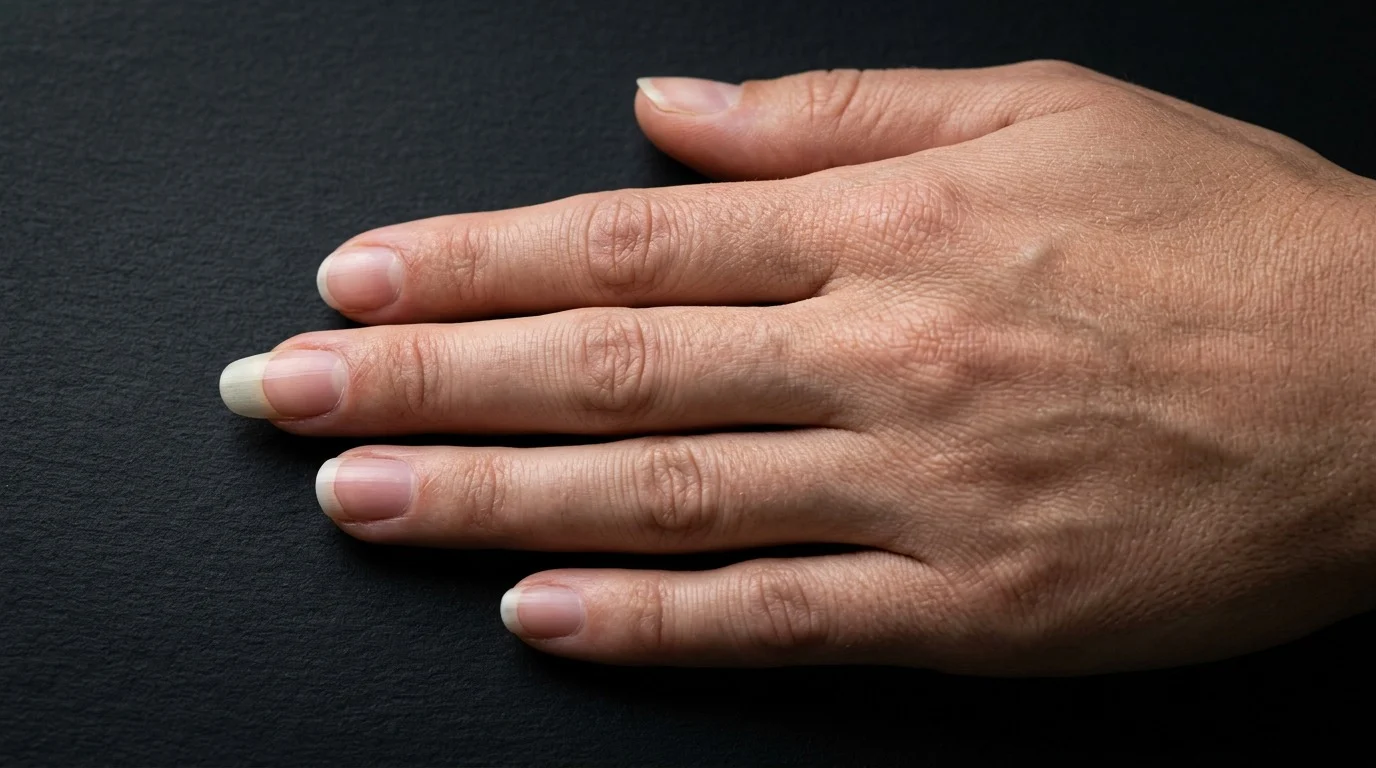
The fact that no one tells you anything about nail growth
Here’s a fact worth sharing at your next dinner party: Your middle fingernail grows faster than any other nail on your hand. Not your index finger, not your thumb, your middle finger. Nail growth actually varies from finger to finger, and scientists have known this for decades. Most of us have never thought to ask why.
On average, fingernails grow about 3.5 millimeters per month. That amounts to roughly 0.1 millimeters per day, or about 4 centimeters per year. Toenails grow at about a third of that rate. But behind those averages lies a lot of fascinating variation, variation driven by biology, circulation, the seasons and even which hand you write with.
💡Key takeaway
The speed of your nail growth is determined by circulation, age, season and the hand you use most, and not by chance. Understanding these factors can help explain why nails look and behave differently from person to person, and why the same nails can change noticeably over the course of the year.
Why does the middle finger win?
The answer comes down to height and blood flow. Longer fingers have more tissue, which means more blood vessels that supply nutrients to the nail matrix, the small band of living cells tucked just beneath your cuticle where all nail growth originates. More circulation means more keratin production, and more keratin means faster growth.
The nail matrix is the engine room of the entire process. It produces keratin cells that harden and flatten as they travel, eventually forming the visible nail plate. If you want to understand what happens when that engine room is disrupted, the science behind nail matrix damage explains it clearly. But if everything works properly, the matrix continues to produce quietly, day after day.
The little finger, the shortest digit, has the slowest nail growth of the five. Your index and ring fingers are somewhere in the middle. It is almost perfectly proportional to finger length.
Dominant Hand Nail Growth: Is It Really Faster?
Yes, and by a noticeable amount. Your dominant hand grows nails about 10 percent faster than your non-dominant hand. The reason is increased blood circulation. When you use one hand more, you stimulate blood flow to the fingers, and that extra circulation delivers more oxygen and nutrients to the nail matrix, which speeds up keratin production.
There is also a mechanical element. Regular, gentle tapping, as you naturally do when typing or tapping on a desk, stimulates nail growth. It is a small effect, but it adds up over months and years. Your dominant hand benefits from both circulation and this low mechanical stimulation all day long.
This may also be a factor why nail biters sometimes find that their bitten nails seem to grow back quickly. The increased blood flow from the habit can briefly contribute to faster nail growth, even though the habit itself can damage the nail plate.
Nail Growth by Season: Summer Wins
If your nails seem to grow faster in the summer, you’re not imagining it. Research consistently shows that fingernail growth peaks in the warmer months. The mechanism mirrors the dominant hand effect: heat can cause blood vessels to dilate, increasing circulation to the extremities, including the fingertips. More blood flow, more nutrients, faster keratin production.
A study published in the Journal of Investigative Dermatology shows that nail growth can be almost 20 percent faster in the summer than in the winter. That’s a significant difference for something most people consider a coincidence.
In winter, the body retains heat by reducing blood flow to the hands and feet. The nail matrix still works, but at a slower pace.
It’s worth noting that the summer heat isn’t entirely kind to the nails. While growth accelerates, the heat and humidity can also affect the structure and hydration of the nail plate. The full picture of what warm weather does to your nails is more complicated than just faster growth.
How age changes the nail growth cycle
Nail growth slows down as we age. Children’s nails grow the fastest, their fast metabolism and high blood circulation ensure a fast nail growth cycle. Growth peaks in early adulthood and gradually declines from about the mid-30s.
By the time a person reaches 70, their nails can grow about half as fast as they did when they were 20. The nail plate also tends to become thicker and more brittle over time. The matrix produces cells more slowly, so the nail has to harden longer before it reaches the free edge. This is why older adults often notice nails that look different in texture, and not just in length.
Hormones also play a role. Pregnancy is one of the most dramatic accelerators of nail growth, with many women reporting noticeably faster growth during their second and third trimesters. Thyroid function may also be linked to keratin growth rate. Both an overactive and underactive thyroid can be linked to changes in how fast nails grow and how healthy they look.
Nutrition, keratin and what actually stimulates growth
Nails are made almost entirely of a protein called keratin. Protein intake is therefore important. But the relationship between diet and nail growth is not as direct as supplement marketing suggests.
A well-nourished body allows nails to grow at the natural genetic rate. Severe nutritional deficiencies, especially of biotin, iron and zinc, can slow growth and affect the quality of the nail plate. But taking supplements when you are already well nourished does not significantly speed up the process.
Hydration is more important than most people expect. The nail plate contains water and when the body dries out, the plate becomes brittle and peels off easily. Brittle nails that break off at the tips can give the feeling that your nails are not growing, when in reality they are growing and simply break off before you notice the length.
Nail growth statistics worth knowing
A few facts about nail growth that surprise people:
-
Fingernails grow roughly four times faster than toenails.
-
The thumbnail is one of the slowest growing fingernails, despite being the widest.
-
It takes about 4-6 months to completely replace a fingernail, from matrix to free edge. Toenails last 12-18 months.
-
Nails grow slightly faster during the day than at night, following the body’s circadian rhythm and activity levels.
-
Disease can temporarily slow nail growth, and this may be accompanied by a visible horizontal ridge called Beau’s line.
That last point is especially striking. Your nails silently record your health history in keratin. A bout of illness, stress or poor nutrition can literally leave a mark on the nail plate, a physical timeline etched into the structure of the nail itself.
Why your ring finger feels different
Many people notice that their ring fingernail grows shorter or slower than the others. This is partly anatomical. The ring finger has slightly less independent movement than the other fingers, meaning it receives less mechanical stimulation on a daily basis. It also tends to be less involved in dominant grip actions. Less movement, slightly less circulation, slightly slower nail growth.
Small differences, but real ones.
Understanding the nail growth cycle also helps explain why nail shapes look so different from person to person. The width of the nail matrix determines the width of the nail plate, and this is largely genetic. If you’ve ever wondered why some people seem to naturally have long, narrow nails while others have wide, flat nails, the answer starts with the matrix. For more information on how nail shape relates to your hand’s natural proportions, the guide to finding the best nail shape for your hands is worth a read.
The nail growth rate you experience is not random. It’s an accurate reflection of your circulation, your age, the season, your dominant hand and your overall health, all written out in keratin, millimeter by millimeter.
Knowing the biology behind nail growth will change the way you approach nail care. Nails that look short or brittle often have a story behind them, and understanding that story is the first step to doing something about it.
If you want to dive deeper into nail science and put that knowledge to practical use, MyNailEra is built for just that. With in-depth guided lessons from 12 award-winning nail artists and Era, your personal nail coach, you can gain a real insight into nail health and technique. See how it works in the app.