

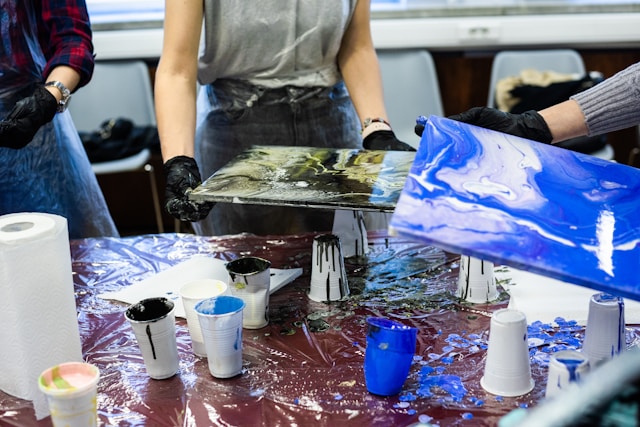
Emotional pain does not always speak in sentences. Sometimes it hides behind silence, tears or tightness in the chest. At these moments, art therapy offers a different kind of language – a built on colors, shapes and symbols.
Art therapy helps people to express pain and process in ways that words often cannot. It offers a safe space to explore difficult feelings, traumatic memories and buried emotions through creative expression. For many, the use of color and symbolism becomes a path to healing.
This article investigates how the use of colors and symbols in art therapy enables people to release pain, understand emotions and make contact with itself again.
What is art therapy?
Art therapy is one mental health Practice that combines the creative process with therapeutic support. It is led by trained professionals who use art -based techniques to help individuals by working emotional and psychological challenges.
You don’t have to be an artist. The goal is not to create something beautiful – it is to give meaning. By drawing, painting, collage or sculpture, people explore their thoughts and feelings visually.
According to the American Art Therapy Association, art therapy improves emotional resilience, self-awareness and coping skills, especially for people who recover from trauma or deal with anxiety, depression or addiction 1.
Why visual expression matters
Not all emotions are easy to explain. Some trauma survivors may have no words for their pain. Others may feel overwhelmed or afraid of speaking.
That is where visual expression becomes powerful. With the help of colors and symbols, people can express what they feel without having to speak. This kind of creative release offers a bridge between the inner world and the outside world – a way to be kept in silence for too long.
A study from 2017 published in Frontiers in Psychology Discovered that trauma survivors who participated in art therapy showed emotional regulation and reduced PTSD symptoms, especially when encouraged to use symbolic images 2.
The language of color in art therapy
Colors can immediately communicate emotions. Without explaining, a single color can reflect a mood, a memory or an emotional state.
Common emotional associations with colors:
- Red: anger, intensity, passion, fear
- Blue: sadness, calmness, isolation, peace
- Yellow: joy, hope, energy, fear
- Black: sadness, protection, emptiness
- Vegetable: healing, innovation, jealousy
- Purple: transformation, mystery, dignity
In art therapy, clients often choose intuitively in colors. A person can make a painting with dark swirls of blue and black to express sadness. Later they can add yellow or green if they start to feel hope or growth.
Therapists gently examine what each color means for the individual. The goal is not to assign a fixed meaning, but to invite personal reflection and emotional release.
Use symbols to tell the story
Just as colors express the mood, symbols help tell a deeper story. They enable people to express painful experiences through images, shape emotions that feel abstract or overwhelming.
Common symbols in art therapy include:
- Trees: growth, grounding, family history
- Home: Safety, childhood, living at home
- Paths or weighing: Life Journey, direction, Uncertainty
- Heart: love, loss, vulnerability
- Doors/windows: escape, opportunities, barriers
- Water: Emotions, cleaning, depth
Symbols often appear spontaneously. A person who processes youth trauma can attract a cracked house. Someone who mourns a loss can outline an empty chair. These images become metaphors – visual instructions for the feelings they wear.
In one session, a customer can attract a river that is blocked by stones. Over time, the stones can shift and show movement in healing and emotional current.
The safety of symbolic distance
One of the main reasons why colors and symbols are effective in art therapy is that they offer emotional distance. Instead of re -experiencing a traumatic event, customers can represent the metaphorical.
This symbolic distance makes it easier to process painful memories without getting overwhelmed.
A study from 2016 in Art therapy: Journal of the American Art Therapy Association Discovered that individuals who use symbolic images in art therapy sessions have reported lower levels of emotional need and an increased ability to think about difficult experiences 3.
This is especially useful for those who have experienced trauma or complex sorrow.
Real-life example: healing by color and symbol
Lena, 28, started art therapy after survival of emotional abuse. She struggled with words. Her therapist encouraged her to start with colors.
“In the beginning I painted a lot of black. I didn’t even think about it. One day I added a red line over the page. That red felt like anger – anger I had never allowed myself before. After a few months I started adding green and yellow. I was healing, although I didn’t say much.”
Lena’s story shows how colors and symbols can contain pain and transformation, in powerful, quiet ways.
What a session could look like
In a typical art therapy session aimed at emotional pain, the therapist can:
- Invite the client to choose colors that represent how they feel.
- Suggest to draw a symbol or scene from a recent memory or dream.
- Explore the artwork together through open questions:
- “What does this shape or color mean to you?”
- “Where do you feel this emotion in your body?”
- “What would you add to this image to show healing?”
Customers can talk as little or as little as they want. The artwork becomes the voice.
Getting started with colors and symbols at home
Although working with a certified art therapist is ideal, you can start exploring this process at home as part of your self-care or healing routine.
Try this:
- Mood painting: Only use colors (no images or shapes). Pain how you feel.
- Symbol collage: Cut symbols from magazines that reflect your current emotions.
- Visual journalization: Draw an object every day that reflects how your heart feels.
- Coloring line: Create a color-coded journey of your life-elke phase marked with a different shade.
These activities can provide insight and lighting, especially in times of stress or reflection.
Last thoughts: Art as a language for healing
Not all pain needs words. Sometimes it needs color. Sometimes it needs a symbol that only you understand.
The use of colors and symbols in art therapy offers a way to process emotional pain with safety, creativity and compassion. This allows you to explore what is in it without judgment. It gives shape to things that were once invisible, and with that it opens the door to healing.
You don’t have to be an artist. You just need the willingness to express. With every brush rock or pencil line you get a step closer to understanding, release and peace.
Sources
- American Art Therapy Association. (2023). What is art therapy? [https://arttherapy.org] ↩
- Haeyen, S., et al. (2017). Art therapy and symbolic expression with trauma treatment. Frontiers in Psychology. ↩
- Kaimal, G., Ray, K., & Muniz, J. (2016). Symbol use and emotional regulation in art therapy. Art therapy journal. ↩