

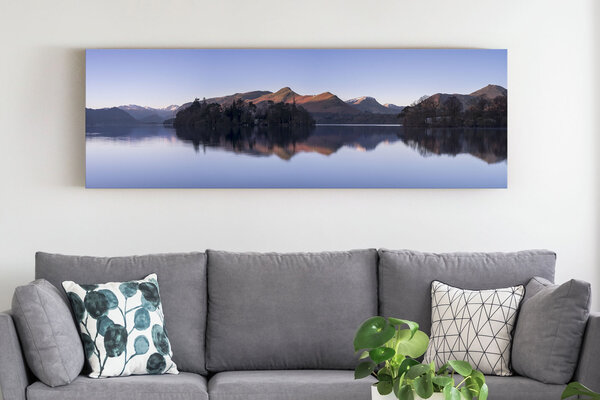
When we think about improving our health, we tend to focus on diet, exercise and sleep. We rarely consider the visual environment we return to every day. Yet the images on our walls are not neutral. They set the atmosphere, influence the mood and silently influence how we feel in our own home.
Most of us spend a significant amount of our time indoors, especially in shared spaces like the living room. Here we relax after work, talk to family, scroll on our phone, watch movies and receive friends. It is a transitional space between the demands of the outside world and the privacy of family life. What surrounds us there is more important than we might think. So let’s explore why having art in your living room supports your well-being more than you think.
The psychological effect of visual environments
Research in environmental psychology suggests that what we see repeatedly can influence our emotional baseline. Certain types of images – especially natural landscapes, water scenes and open horizons – are associated with lower stress and better mood. This is often associated with what psychologists call “attention recovery”: the idea that soft, absorbing images allow the brain to recover from cognitive fatigue.
Simply put: some images ask very little of us. A calm seascape, a misty forest or a sweeping mountain vista require no interpretation or analysis. It provides visual breathing space. In contrast, very cluttered, chaotic, or intensely contrasting images can stimulate rather than calm.
Color also plays a role. Cooler tones such as blue and green are often associated with calmness, while softer neutral tones can create a sense of balance. This doesn’t mean that bold art is harmful or undesirable, but if the goal is to create a restorative environment, composition and color palette are worth considering.
Why the living room is so influential
The living room often sets the emotional tone of the house. It is usually the largest common area and the one that is used the most. Because of this, it has a disproportionate impact on how the house feels overall.
If the room feels visually noisy or overstimulating, this can subtly prolong the feeling of busyness we carry from the outside world. On the other hand, carefully chosen works of art can support a slower, calmer rhythm. A single large-scale photographic print with depth and perspective can create a focal point that grounds the space rather than fragmenting it.
Scale matters. Multiple small frames with competing colors and subjects can add energy, but they can also increase the visual load. A carefully selected piece with space, balance and a clear horizon line often feels calmer.
Images of nature and the idea of ’soft fascination’
One of the most consistent findings in well-being research is the restorative effect of nature. While nothing replaces time spent outdoors, even images of natural environments can evoke a similar response. This is also called ‘gentle fascination’: the mind is gently engaged, but not tense.
Photographic wall art is particularly interesting in this context. Because photography captures real places and light, it can evoke a sense of presence. For example, a coastal image with a distant horizon can introduce a sense of openness to a confined interior. A forest landscape can add depth and layers that contrast with flat walls and hard surfaces.
It’s not about turning your living room into a themed space. These are subtle signals. An image that suggests distance, silence or natural light can change the perception of a room.

Intentional curation rather than decorative filler
Many of us choose wall prints as an afterthought – something to fill an empty space. But when artworks are selected deliberately, they become part of the emotional architecture of the space.
Ask simple questions:
- Does this image feel soothing or stimulating?
- Does it give my eye some rest?
- Does it complement the light and tones that are already present?
Many online galleries curate special collections for shared spaces like the living room, making it easier to discover photography, paintings or digital artworks that complement your interior design. For example, Fotoviva Art Prints offer a collection of photographic wall art designed for living rooms.
The key is not the brand or the price, but the alignment between the artwork and the atmosphere you want to create.
Practical ways to create a more restorative living room
If you want to support well-being through your home environment, consider the following:
- Choose images with visual depth – open skies, water, landscapes or scenes with perspective.
- Avoid overly busy compositions if your goal is quiet.
- Place artwork at eye level to create visual balance.
- Make sure the tones in the artwork match upholstery and wall colors to reduce contrast.
- Choose one strong central piece instead of multiple competing pieces.
None of this requires a complete redesign. Sometimes replacing a single piece of art on the wall can subtly change the mood of a room.
The silent role of art in everyday health
Well-being is rarely the result of one dramatic change. It is shaped by small, consistent influences. The light in a room. The noise levels. The comfort of a sofa. And perhaps more than we realize, the images we live with every day.
Your living room is the place where you return to reset. If the artwork on your wall supports calm, balance and a sense of space, it may be doing more for your well-being than you ever consciously acknowledge.