

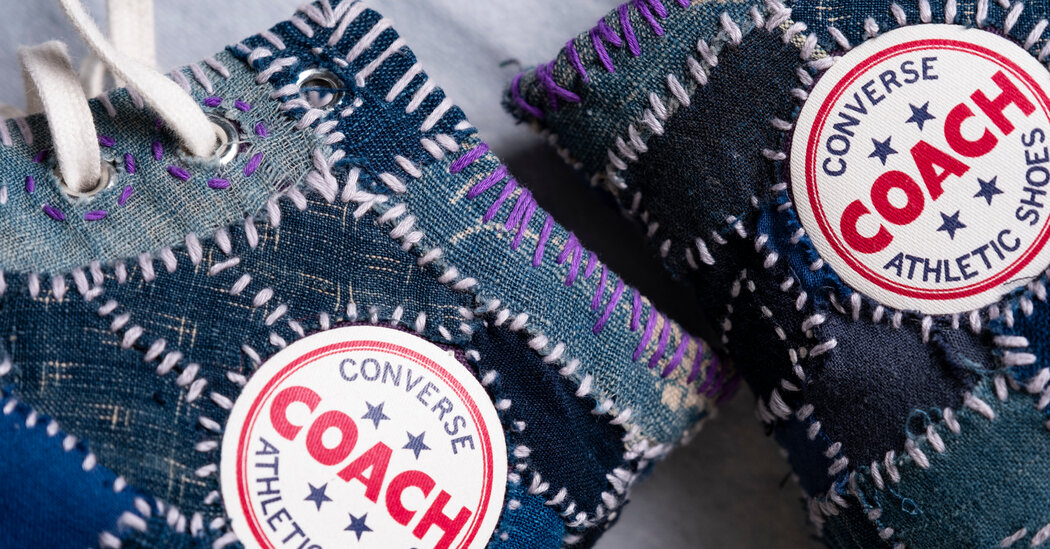
Atsuko Sato, one of the three needle women who were present that day, showed me a few converses covered with cotton pieces in different shades of blue and accentuated with some purple stitching. “This type of fabric is very soft, so it wasn’t that hard to sew,” said Mrs. Sato, 66. “But later I started working on different materials, and some are very difficult.”
At that moment she indicated that a few new balance sneakers she said she had taken her colleague, Ruiiko Ishii, a total of 23 hours to complete.
Mrs. Ishii, 79, who was also in the office that day, had worked as a laboratory technician before the Tsunami. “I lost almost everything, my house, my husband,” she said. “I was desperate. At that moment I felt the worst in my life.”
She was one of the women who learned the technology in the evacuation center. “I was not good at sewing,” she said, “but I decided to try. I was so overwhelmed by the atmosphere in the workshop. So hospitable, so loving, so calming. I found some hope there.”
Mrs. Goto, 77, said she had found Sashiko work as very calming. “Before that, although I watched TV, I couldn’t really hear it,” she said, referring how difficult it was to bypass all her worries. “But when I started sewing, I was able to concentrate on it and I could forget the experience I had undergone.” While she was talking, she had been using a long needle with a slightly bent end to sew a pattern with multicolored wire on a dark blue tablecloth painted with Indigo.
The women said they were talking about how they could spread the word about Sashiko and eventually perpetuated their project.