

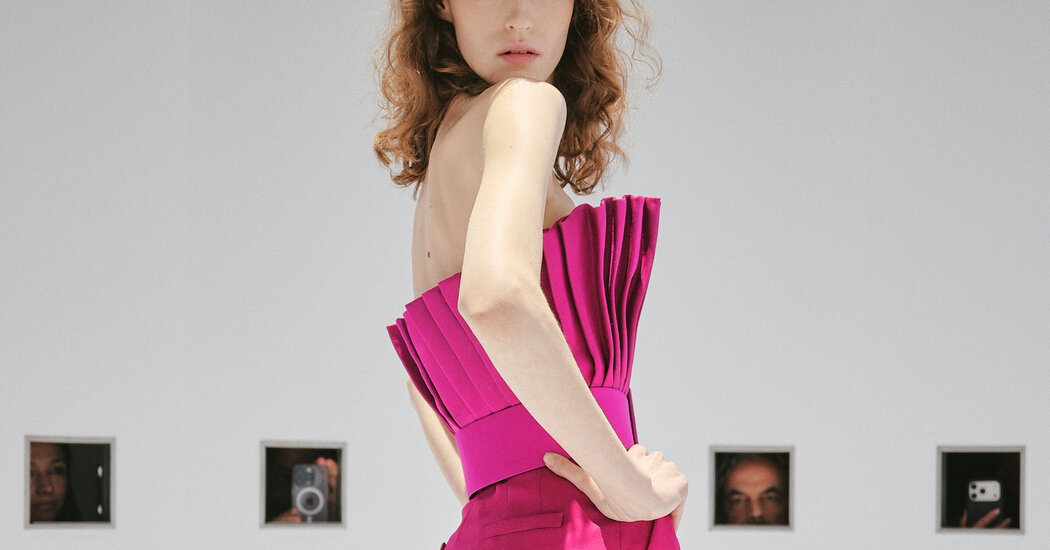
I know models have always been skinny, but it seems to me that they are getting even skinnier. They are clearly not the target market for Ozempic, so am I being misled, or is this true, and if so, what is going on? –Andrea, Kansas City, Mo.
You are not deceived. As I sat at the recent couture shows and then flipped through photos looking for runway images to match the show reviews, I had the same thought.
The figures confirm this: during the last ready-to-wear season, according to the Vogue Company Size Inclusivity ReportOf the 9,038 looks in 198 women’s clothing shows, 97.1 percent were shown on models wearing U.S. sizes 0 through 4. Less than 1 percent of models qualified as plus size or curvy.
There was a point when fashion seemed to be moving towards body positivity, partly because of public opinion. In 2020, Paloma Elsesser, an outspoken plus-size model, was on the cover of Vogue, and the following year she joined the VS Collective specifically to help Victoria’s Secret rethink sizing and its image. The concept of medium-sized models took off and there was less symbolism for plus-size girls. But that moment has clearly passed, for several reasons.
The backlash against “wokeness” has increased the inclusiveness of its scope in its wake. Fashion, which is declining in many ways, including sustainability and gender equality, is also returning to runway form. After all, it is easier to stick to the status quo than to pioneer change.
This is especially true of catwalk collections, as these generally consist of sample garments, designed in a standard size. (It’s more efficient and cost-effective.) Varying sizes on the runway requires changing the patterns, and that requires rethinking the system, which is complicated.
Furthermore, conventional industry wisdom holds that clothes look better on women in the form of pendants. Not the quilted silk kind; the narrow thread type.
Then there’s the fact that the GLP-1 revolution has changed the visual landscape. As previously larger people shrink in the public eye, so too do our perceptions. What qualifies as “skinny” becomes even skinnier – and seemingly more desirable.
Add it all up and the appeal is towards an ever-shrinking human form, especially on the catwalk. It’s a shame. Not because thinness is bad, but because it shouldn’t be the only option. People still come in all shapes and sizes. It is actually more attractive to see the reality of life reflected on the catwalks, which have become a form of entertainment for everyone, than to see life reduced to one size that does not fit all.
The reality of this became clear when, after decades of racism, fashion finally stopped tokenizing black models and embraced a multitude of skin tones in runway collections instead of opting for a 90 percent white model cast. (Well, except for Dolce & Gabbana, who inexplicably have one completely white released in the last men’s show.) The result was shows that look exponentially richer and more relevant than they ever were, because they are more clearly connected to the world in which the clothes they show are worn.
The conclusion should be: the more diversity, the better. Not only in terms of breed, but also in terms of size, age and physical capabilities. It is in everyone’s interest. Imagine seeing a runway with not only sizes 0 and 16, but also all sizes in between, including 6, 8 and 10.
And not just for women and women’s clothing. At the recent men’s shows, the guys on the Prada catwalk were so slim that Hanan Besovic, the fashion commentator who posts under the hashtag @ideservecouture, was on his Instagram role: “I love Prada. But my only thought during this entire collection is how skinny these models are.”
“It was so hard to concentrate on the clothes,” he continued.
There is a lesson in that if fashion wants to learn it.
Your style questions, answered
Every week on Open Thread, Vanessa answers a reader’s fashion-related question, which you can send to her at any time e-mail or X. Questions are edited and condensed.