

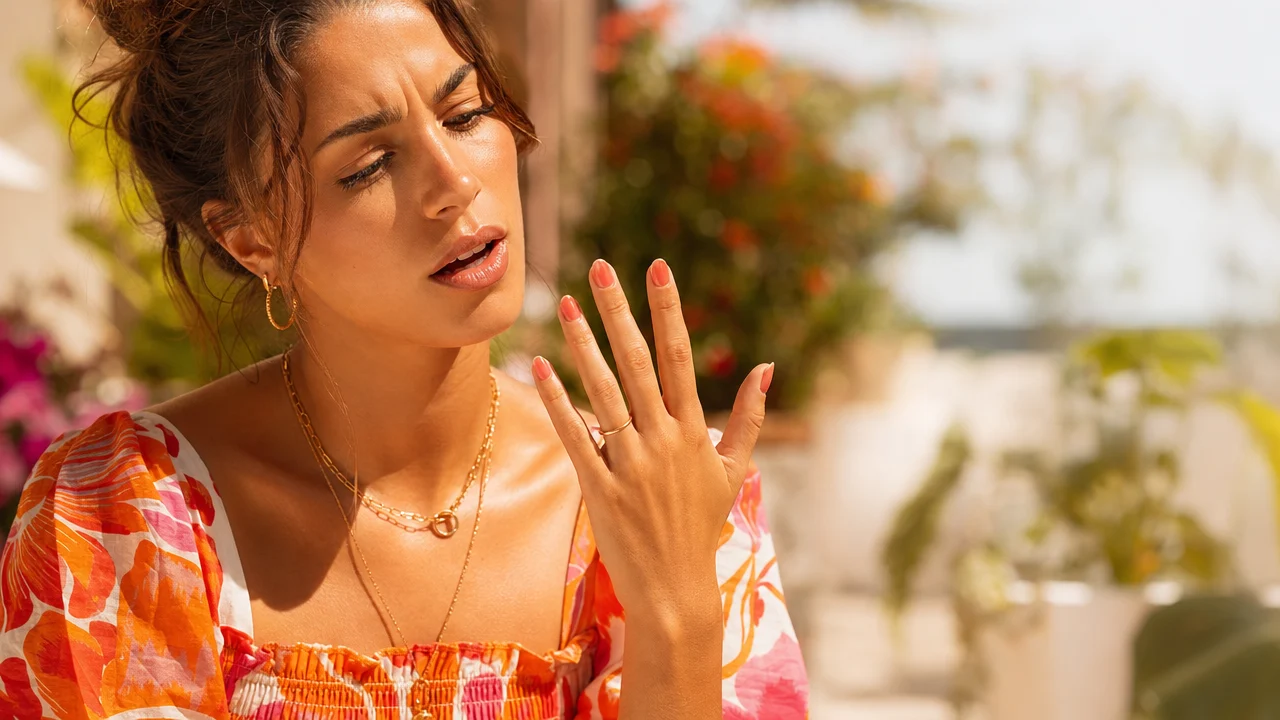
Summer is coming and suddenly your nails have opinions. They peel, they lift, they snap at the worst possible time, and no amount of nice polish seems to last as long as it does in January. Sound familiar? You’re not imagining it.
Heat does something very fascinating to your nails, and most people have no idea that this happens on a biological level. Nails in warm weather are a real phenomenon, and the science behind why summer is the toughest season for your nail health is actually pretty amazing.
Right now, with heat waves getting longer and more intense every year, the conversation is happening summer nail care sounds louder than ever. Beauty editors, nail artists, and millions of people on social media all ask the same question: Why are my nails falling apart in the heat?
💡Key takeaway
In hot weather, your nails are under real biological stress. The nail plate expands in heat, keratin dries out faster than you would expect, sweat disrupts the adhesion of the gel and the nail matrix can produce more vulnerable cells during heat waves. Understanding this science can help you protect your nails all summer long.


Your nails actually breathe differently in the heat
Here’s something most people don’t know. Your nails are porous. They constantly absorb and release moisture, and as temperatures rise, that process speeds up dramatically.
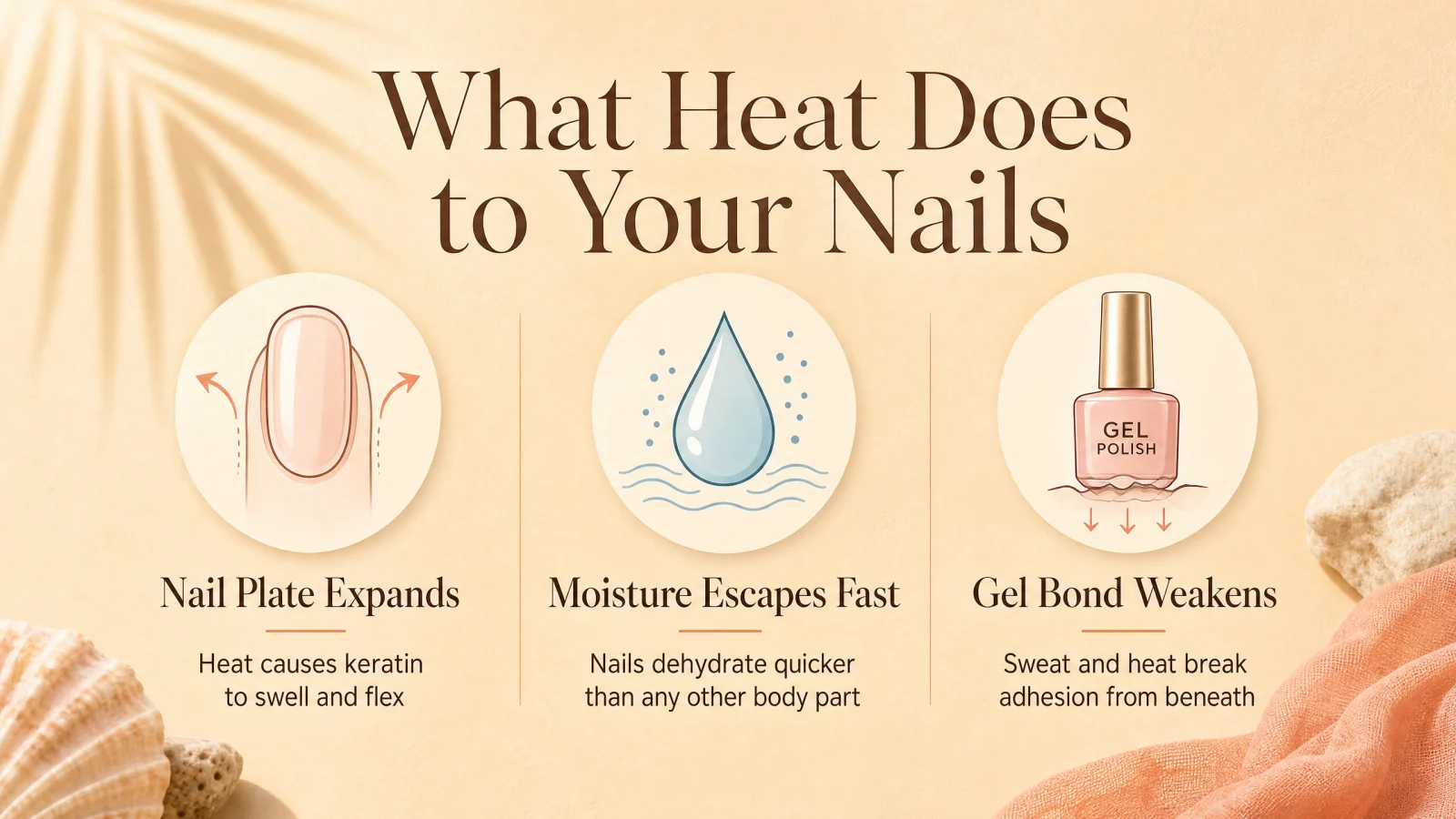
The nail plate consists mainly of keratinthe same fibrous protein that makes up your hair. Keratin is excellent at retaining structure, but is really sensitive to extreme temperatures. In warm weather, the nail plate expands slightly as it absorbs more moisture from the environment, and then contracts and dries out as that moisture evaporates.
That constant cycle of swelling and shrinking is tiring for the nail. Over time, it weakens the connections between the keratin layers.
This is why peeling nails And brittle nails tend to peak in summer, not winter. Cold is blamed, but heat is often the real culprit.
The role of the nail matrix
Everything that makes up your nail starts deep beneath the skin, with the nail matrix, the living tissue that produces the nail plate. During hot weather, changes in hydration, circulation, and the condition of the surrounding skin can affect how your nails look and feel, even though the nail itself is made of dead keratin.
It’s a subtle shift, but over an entire summer of heat waves, those small changes add up. The nails you grow in August often behave very differently than the nails you grow in March.
Sweat changes everything
Sweaty hands are more than just uncomfortable. Sweat forms a film between your nail and the product on it, which is one of the main reasons gel nails lift in warm weather is such a common complaint.
The chemistry of the bond depends on a clean, dry surface. Heat and perspiration disrupt that bond from below, often invisibly, until one day the edge of your gel just… rises. You can read more about exactly why that happens in this deep dive on gel nails that lift in warm weather.
Why dehydration hits your nails before it hits the rest of you
Your body is smart about prioritizing hydration. When you are running low on fluid, the fluid is first directed to your vital organs. Your nails are last on that list.
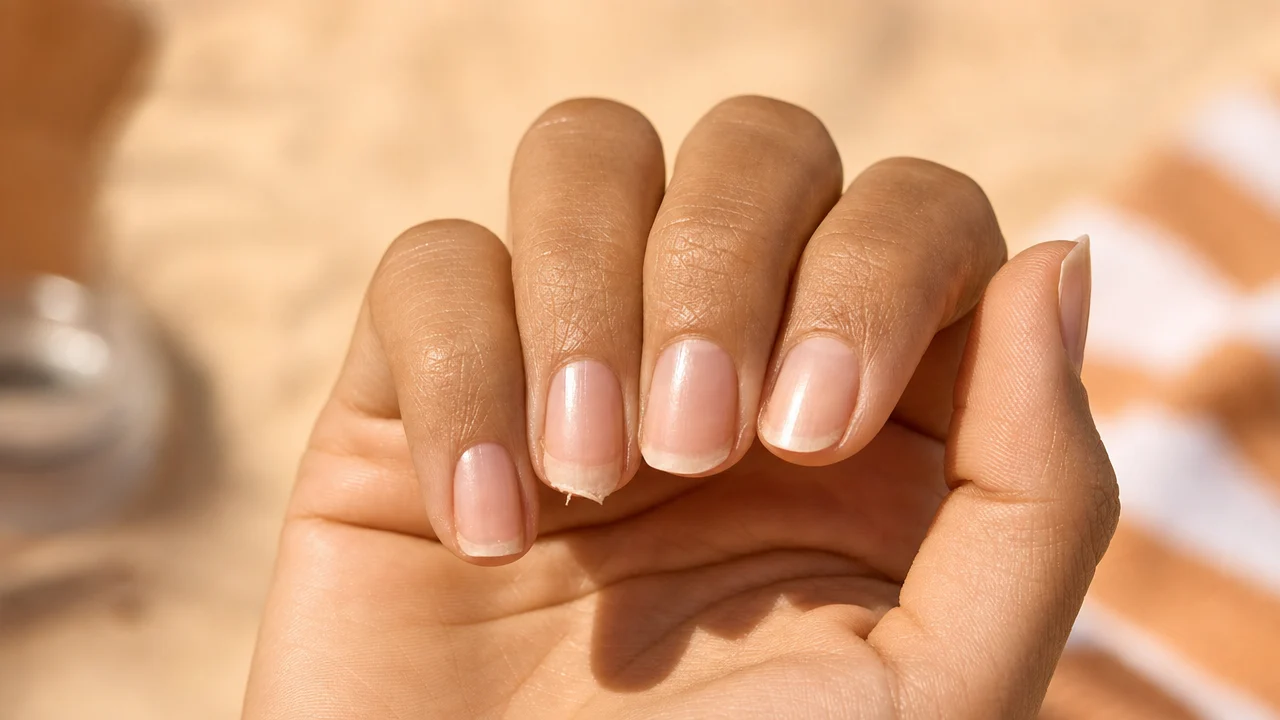
Nail dehydration appears quickly in summer because nails do not have their own oil glands. They are completely dependent on the moisture that migrates from the surrounding skin and the products you apply. When the heat increases, that supply decreases faster than you would expect.
The result? Nails that look dull, feel rough around the edges and are split at the tip into those little, maddening layers.
Dry cuticles are a warning sign worth paying attention to
Dry cuticles in summer are not just an aesthetic issue. They are a signal that the entire nail environment has dried out.
The tissue at the base of your nail plays a protective role that most people underestimate. It seals the gap between your nail plate and your skin, keeping bacteria and moisture out. When it dries out and cracks, the seal is compromised. It’s worth understanding what you’re actually looking at down there, because what most people think of as their cuticle isn’t quite what they imagine. This piece on what your cuticle actually is will really surprise you.
It is no vanity to keep that area soft and nourished all summer long. Are maintenance of nail health.
The gel nail problem that no one talks about enough
Gel manicures are brilliant. They are also particularly vulnerable to summer conditions, and the reasons are more nuanced than most people realize.
When your natural nail expands from the heat, it moves. The gel that sits on top is a stiff layer that doesn’t bend in quite the same way. Over time, especially with repeated exposure to heat, water and sun, this mismatch creates tension at the edges and underneath the product.
Gel nails in warm weather are faced with a kind of structural tension that simply does not exist in the colder months.
Add in chlorine from swimming pools, salt from the sea, and the general increase in hand-washing that comes with summer activities, and you have a recipe for a manicure that looks perfect on Monday and blooms by Thursday.
The science of what a top coat actually does is fascinating in this context. A high-quality top coat acts as a flexible seal over the entire manicure, and in the summer that flexibility is more important than ever.
The colors and styles that actually hold up in the heat
Not all nail looks are the same as temperatures rise.
Lighter, more sheer formulas will have less noticeable color lifting and crumbling than deep, opaque colors. That’s part of why jelly nailsglazed finishes and sheer styles dominate every summer trend cycle. They look intentionally soft even as they age, giving you a few extra days of wearable beauty.
Shorter nail lengths really do better in the summer. A smaller surface area means less opportunity for the nail to bend and strain the product on it.
If you’re looking for inspiration for what’s really trending this season, the summer nail trends currently taking over every feed are full of looks that work beautifully in the heat.
What this means for you
- Your nail plate expands when exposed to heatmeaning that any product on top of it will experience more stress in the summer than in the colder months. Shorter lengths and flexible formulas tend to last longer.
- Dry cuticles are an early warning sign from dehydration of the nails. If yours are cracking or peeling, your nails themselves are probably dried out as well.
- Gel lifting in the summer is a structural problemnot just a preparation problem. Heat, sweat and natural nail expansion all play a role, so don’t automatically blame your technique.
- Nails grown during a heat wave can really be more fragile than nails grown in the spring. The nail matrix responds to internal body temperature and hydration level.
- Hydration is important from the inside out. Drinking enough water in the summer has a direct impact on how your nails look and behave. It sounds simple because it is.
Your nails need a summer game plan
Receive personalized nail guidance from Era, your nail coach in the MyNailEra app.


Summer is cruel to nails, but now you know why
There’s something strangely comforting about realizing that your nails aren’t just hard. They respond to real biological and chemical pressures that increase every summer. The heat, the sweat, the fluctuating hydration, the way keratin expands and contracts — it all adds up to a season that truly demands more from your nails than any other season.
The beauty world is catching up on this conversation. Heat wave nail care is becoming a real category, and not just a footnote in the summer beauty rounds. And that’s a good thing, because your nails deserve attention all year round, and not just a new coat of nail polish.
If you want to go deeper, the MyNailEra app is where this knowledge becomes personal. Era, your personal nail coach in the app, gives you customized feedback on your specific nail concerns, guides you through the techniques of award-winning nail artists and helps you build a routine that actually works for your nails in any season. Download MyNailEra and let Era show you exactly what your nails need this summer.