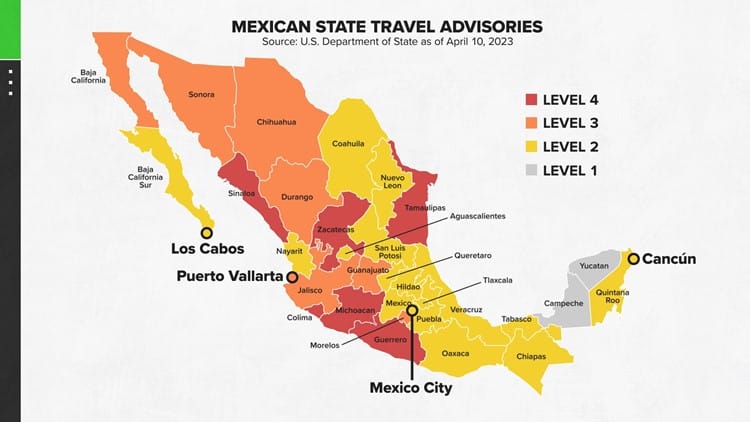
Mexico is generally safe for cautious travelers. However, it is critical to recognize that the crime landscape in Mexico varies significantly from state to state.
Read on to see which states have an increased travel advisory from the US Department of State.
The US government’s warnings should not be ignored, as the high crime rates in these areas pose a serious risk to public safety.
Fortunately, these areas are not near major tourist destinations, so visitors will be largely safe.
LATEST NEWS from Mexico:
March 1 – The U.S. Embassy in Mexico issues a warning about spring travel to the country
The US embassy and consulates in Mexico released a message travel warning for Americans planning to visit Mexico over spring break. The advisory, published on Monday, highlights several potential safety concerns, including crime, for the popular destination.
“U.S. citizens should exercise greater caution in the downtown areas of popular spring break locations, including Cancun, Playa del Carmen and Tulumespecially when it’s dark.”
Read on to find out which locations you shouldn’t travel to.
Areas to avoid in Mexico
These are the regions designated as level 4 by the US Department of State. This designation indicates that U.S. citizens should avoid travel to these areas due to the increased risk of life-threatening hazards. The department indicates that the U.S. government may have minimal capacity to provide assistance in the event of an emergency.
(Level 4) – Do not travel to:
- State of Colima because of crime And kidnapping.
- Guerrero state because of crime.
- Michoacan state because of crime And kidnapping.
- State of Sinaloa because of crime And kidnapping
- Tamaulipas stands due to crime And kidnapping.
- Zacatecas stands because crime And kidnapping.
US travel advice
The US Department of State advises citizens to do the same extra careful. because of the crime in the country. They tell us that Mexico is a country where both violent and non-violent crimes occur.
The agency claims that in many parts of Mexico, the U.S. government’s ability to provide emergency services to its citizens is limited. (Read above: “Areas to Avoid in Mexico.”)
Travel advice for Canada
According to the Canadian government, citizens should do so be extra careful in Mexico due to the high level of criminal activity and kidnapping incidents.
It also called on citizens not to travel to the following areas:
Avoid all travel to
Guerrero
In cities and on highways there is a risk of armed conflict, banditry and looting.
Ixtapa/Zihuatanejo and Taxco are not included in this advice, but you should proceed with extreme caution in these areas.
Avoid non-essential travel
Due to high levels of organized crime and violence, we recommend that you do not travel to the following areas unless absolutely necessary:
- “All Chihuahuas
- all of Colima, except the city of Manzanillo
- all of Coahuila, except the southern part of the state on and below the Saltillo-Torreón highway corridor
- all of Durango, except Durango City
- in Guanajuato
- Highway 45 between León and Irapuato
- the area south of and including Highway 45D between Irapuato and Celaya
- all of Michoacán, except the city of Morelia
- in Morelos
- the Lagunas de Zempoala National Park and surrounding areas
- the municipality of Xoxocotla
- in Najarit
- the area within 20 km of the Sinaloa and Durango borders
- the city of Tepic
- all of Nuevo León, except the city of Monterrey
- all of Sinaloa, except the city of Mazatlán
- all of Sonora, except the towns of Hermosillo and Guaymas/San Carlos and Puerto Peñasco
- all Tamaulipas
- all Zacatecas”
Common scams

These are some of the most common scams you’ll encounter throughout Mexico.
Counterfeit alcohol: Certain establishments may try to sell you illegally produced alcohol, which can be dangerous. To reduce this risk, ensure that your drinks are served from sealed bottles.
Tampered ATMs: Be careful with high street ATMs as they may have been tampered with to obtain your banking details for fraudulent purposes. It is advisable to use ATMs located in reputable establishments such as shopping centers or banks.
Invoice change: Scammers may engage in bill switching, substituting real money for counterfeit bills. Be vigilant by closely monitoring transactions involving your money.
Car rental fraud: Choose reputable car rental companies to avoid paying additional fees for insurance and other services when returning the vehicle.
Impersonation by fake police officers: Remain vigilant for individuals posing as law enforcement officers and demanding payment for alleged violations. This deception often occurs during traffic stops or on the street for minor infractions, such as public urination. Politely request that any fines be settled at the nearest police station.
Express kidnappings: Be careful when using taxi services, especially if you come from the street. Choose to arrange transportation through apps like Uber, as some drivers engage in express kidnapping schemes that force victims to withdraw large sums of money from ATMs.
Timeshare fraud: Beware of timeshare representatives, often found at airports, who offer incentives in exchange for attending presentations where they pressure people to buy timeshare packages. Firmly reject any offer if you are not interested.
Safety Tips for Mexico
Now that you understand the overall safety situation and common concerns, let’s take a closer look at some crucial safety guidelines:
- Avoid unnecessary attention to your finances or business transactions to reduce the risk of kidnapping and extortion.
- Familiarize yourself with earthquake and hurricane safety protocols even before you arrive in the country.
- Stay away from demonstrations and large public gatherings, as participation in political activities is prohibited for foreigners.
- Do not travel outside major cities at night.
- Please respect local dress codes and obey laws regarding the consumption of drugs and alcohol.
- Save local emergency contact numbers in your phone; the general emergency number in Mexico is 911.
- Stay informed of the latest travel advice and local developments through reliable sources.
- Get travel insurance that covers medical expenses, trip cancellations and loss of belongings.