


Category: Buddhist Path | Mind Trainer Articles | Popular | Recent Meditation Posts
Embodying Wisdom, Compassion, and Power
In the realm of Mahayana Buddhism, three revered bodhisattvas are central figures in both teachings and practices: Manjushri, Avalokiteshvara, and Vajrapani. Who exactly are these figures? What do they symbolize? How can we form a relationship with them? Additionally, how might they inspire our own spiritual journeys?
As we explore the concept of bodhisattvas, we find various tiers among them. There are aspiring bodhisattvas, like ourselves, who are on the path of learning about the Mahayana teachings and nurturing our potential to aid others. Conversely, there are realized bodhisattvas—highly accomplished practitioners who have reached profound levels of realization and provide immense inspiration. Among these, three bodhisattvas stand out prominently in Buddhist texts.
Manjushri, the Personification of Wisdom
The first of these great bodhisattvas is Manjushri, who represents the essence of wisdom. In Buddhist teachings, wisdom holds a significant position. While many perceive Buddhism primarily as a practice of compassion and altruism—qualities that are indeed vital—the unique contribution of the Buddha lies in his teachings on wisdom. This form of wisdom encompasses understanding concepts such as selflessness, emptiness, and the nature of the mind; such insights enable our compassion to flourish and become boundless. Genuine bodhicitta harmoniously blends both wisdom and compassion.
Manjushri symbolizes the wisdom imparted by the Buddha. He is often referred to as “the Youthful One,” emphasizing the notion of timeless wisdom—knowledge that is fresh and relevant in every moment. In various Buddhist sutras and Mahayana texts, Manjushri can be seen elucidating the multifaceted nature of wisdom.
In terms of iconography, Manjushri is typically depicted wielding a double-edged sword in his right hand, a tool that symbolizes the cutting of dualistic obstacles—those of self and other. This sword does not need to strike; its mere presence is enough to sever the illusions of duality. In his left hand, he usually holds a lotus flower, upon which rests a text, often the Prajnaparamita, representing the Perfection of Wisdom teachings of the Buddha. Sometimes, he is shown riding a lion, a symbol of confidence and fearlessness.
Avalokiteshvara, the Embodiment of Compassion
The second significant bodhisattva is Avalokiteshvara, whose name in Sanskrit translates to Lord who gazes down upon the world. In Tibetan, he is known as Chenrezig, which means He who perceives with eyes of compassion. Avalokiteshvara’s compassion is said to be boundless. This bodhisattva takes on various forms, reflecting the innumerable ways he assists beings in need. In Eastern Buddhist traditions, Avalokiteshvara may appear in female, male, or androgynous forms. In China, she is known as Guanyin, The One who hears the cries of the world. The mantra associated with Avalokiteshvara, Om Mani Padme Hum, is widely recognized, appearing on prayer flags, carved into stones, and recited by practitioners of Vajrayana Buddhism globally.
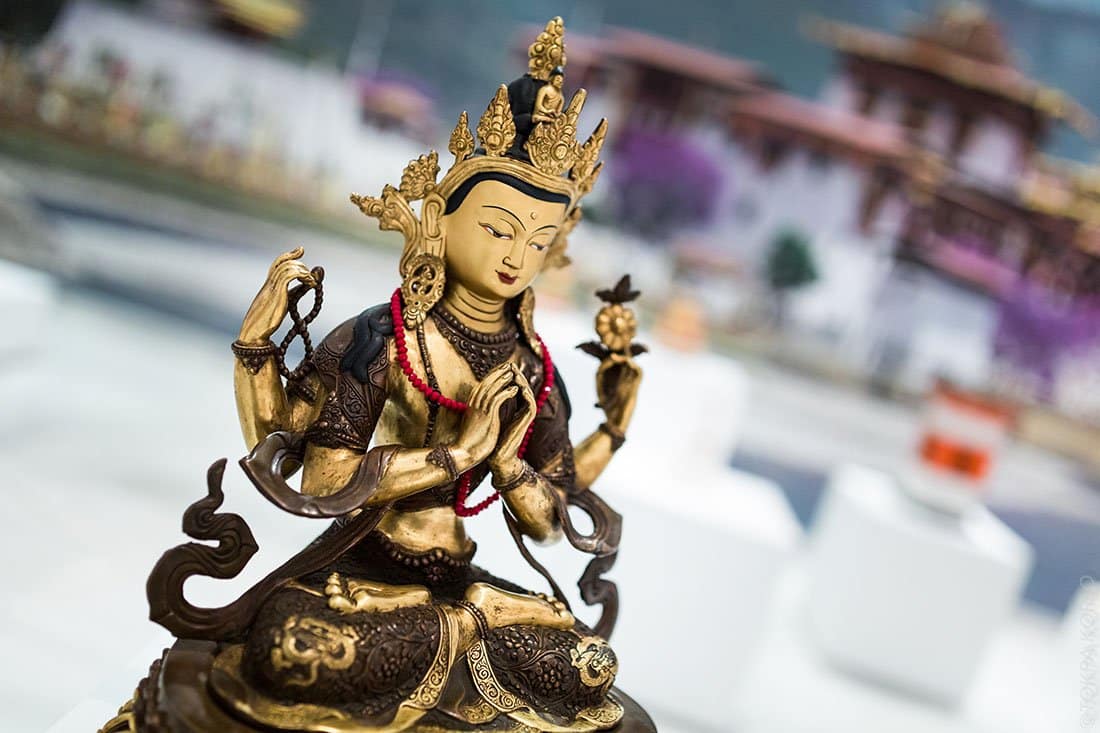
A prominent manifestation of Avalokiteshvara in Tibetan Buddhism is the Four-Armed Chenrezig. His two hands are positioned in a prayer mudra, symbolizing the intention to benefit all sentient beings. In his other right hand, he holds a crystal rosary, while his left hand carries the stem of a lotus flower.
The symbolism surrounding Avalokiteshvara is profound. If our intention is to aid beings, the more hands we possess, the greater our capacity to assist. In some representations, Avalokiteshvara is depicted with a thousand arms and eleven heads, illustrating that when compassion is infinite, so too are the means to be of service.
Avalokiteshvara’s compassionate essence drives him to manifest in whatever form is necessary to assist sentient beings. This could be as simple as a boat or bridge, or as profound as descending into hell realms to aid its inhabitants. It is said that his compassion is so immense that he would willingly endure eons in these realms to save even a single sentient being. His experience of suffering in such realms does not affect him, as he is free from self-cherishing. For him, and other highly realized bodhisattvas, engaging in such altruistic actions is a joy rather than a burden, as they exist without attachment to self. No self, no problem.
Vajrapani, the Essence of Power
The third notable bodhisattva is Vajrapani, who embodies the essence of power. You might wonder, what is the significance of power? If bodhisattvas are wise and compassionate yet lack the power to effect change, their ability to assist beings is limited.
Vajrapani channels this vital energy. His name in Sanskrit translates to “Holder of the Thunderbolt.” The imagery associated with Vajrapani is characterized by his fierce and powerful demeanor, holding a vajra (thunderbolt) that symbolizes the indestructible force of enlightenment capable of dispelling ignorance. Key traits of Vajrapani include a fierce expression, usually dark blue skin, a fiery halo, and a dynamic stance. He often carries a lasso in his left hand to bind negative forces. His role involves safeguarding us from both external and internal obstacles.
Internal obstacles might include negative emotions or thoughts such as, “I can’t possibly continue on this path; it’s too overwhelming for me.” Similarly, external hindrances can manifest in various ways. For example, if someone threatens you, it could derail your practice. While Vajrapani’s protections may not prevent aggression from others, they can empower you to respond differently—allowing you to remain anchored in your practice rather than reacting impulsively. Vajrapani exemplifies strength and the capacity to navigate and transcend obstacles.
Understanding Wrathful Compassion
Occasionally, Buddhist teachings delve into the concept of “wrathful compassion,” a term that may seem contradictory. Isn’t compassion inherently gentle and kind? Wrathful compassion is not about inflicting harm; rather, it is a response to challenges that necessitate direct intervention. Given their obstinacy, formidable obstacles may require equally potent methods to overcome. Wrathful compassion embodies a powerful energy dedicated to surmounting such challenges. This is why Vajrapani often appears fierce and aggressive, yet devoid of any self-reference or ordinary anger. Instead, he embodies confidence in awakened energy, allowing for the avoidance of obstacles.
Many of us encounter significant hurdles in our practice and lives. At times, we need strong remedies—experiences that we have all faced. While we can navigate some difficulties and negative emotions, others may feel insurmountable. Employing the robust skill of wrathful compassion can enable us to break through our self-imposed limitations.
Connecting with the Great Bodhisattvas
How do we relate to these bodhisattvas? Are they mythical superhumans, or should we view them as real entities? We hear tales of Avalokiteshvara engaging with the Buddha or striving to aid all sentient beings—are these simply inspiring narratives, or do they have historical roots?
A challenge we often face is our inability to accurately discern reality. In our daily lives, we frequently confuse what is real with what isn’t. We proceed through life under the assumption that our experiences stem from an individual self, filtering everything through that lens. This perception of separateness influences every aspect of our lives, both intellectually and emotionally. The Buddha’s teachings encourage us to challenge these assumptions.
Given our dualistic view of the world, how can we accurately gauge what is real? This question is complex. On one hand, we should not accept teachings solely based on blind faith. The Buddha encouraged us to develop our own understanding through inquiry and personal practice. However, without some degree of confidence in these teachings, we risk remaining stagnant, unable to break free from the constraints of ego.
It is worth contemplating what we mean by “real.” From a Buddhist perspective, these bodhisattvas exist both as real entities and as symbols. They are/were actual beings. The sutras are filled with references to enlightened beings, detailing their teachings, the contexts in which they were delivered, and the people present. Simultaneously, we can also view them as symbols representing the fundamental nature of reality.
How can we articulate or comprehend the essence of non-dual reality while experiencing the world through a self-other lens? Symbolism serves as a different language to express these concepts. Although it may seem mythological, this does not diminish its significance. Numerous stories recount how Manjushri appears to accomplished meditators, offering guidance. You too can forge a connection with Manjushri; such encounters may not resemble traditional meetings but can occur through your practice and confidence, igniting the enlightened qualities that lie dormant within you.
Many other bodhisattvas are referenced in sutras and various Buddhist narratives—indeed, countless highly realized bodhisattvas exist. Some of the most well-known include Maitreya, the future Buddha, Tara, the embodiment of swift compassion, and Samantabhadra, who excels in making powerful aspirations and prayers.
Great bodhisattvas impart invaluable teachings, clarify the Dharma, and provide insights on navigating challenging situations. However, our practice does not need to be restricted to devotion toward distant revered figures—these bodhisattvas reflect aspects of our own Buddha nature. We can connect with and honor the potential within ourselves to activate the unimpeded wisdom, compassion, and power embodied by Manjushri, Avalokiteshvara, and Vajrapani.