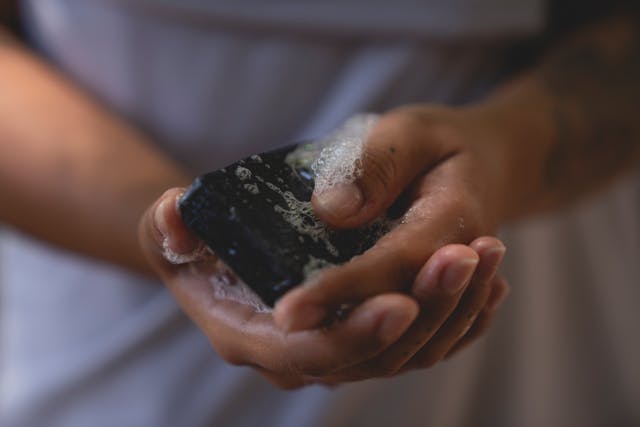
There’s a bar of soap that predates modern dermatology, synthetic fragrances, and the entire commercial beauty industry by about two thousand years. It was used in ancient Syria when the Silk Road traders of Aleppo exported it across the Mediterranean. It was brought back to Europe by crusaders who had never seen anything like it. It quietly influenced the development of the famous French Savon de Marseille. And in December 2024, UNESCO formally included his craftsmanship on the Representative List of the Intangible Cultural Heritage of Humanity.
It contains three ingredients.
Aleppo soap (made from Syrian olive oil and bay berry oil) is not a wellness trend. It’s a return to something that worked before wellness trends existed. And for anyone committed to a truly natural, healthy living routine, it’s one of the simplest and most effective forms of exchange available.
What Aleppo soap actually is
Aleppo soap takes its name from Aleppo, the ancient Syrian city where it has been produced for at least two thousand years, although historical references suggest the tradition is even older. The recipe has not changed: extra virgin olive oil and bayberry oil (Laurus nobilis fruit oil) are boiled together using the traditional hot process method over several days, poured by hand onto a factory floor to harden, cut into strips and then stored underground to dry, sometimes for a year or more.
During curing, the green beams slowly develop a golden brown exterior as the chlorophyll compounds of the bay oil oxidize. Cut open a beam and you’ll see the vibrant green interior still intact beneath the aged surface. That green is preserved, active laurel oil. The deeper the brown outside, the longer the bar has hardened and the better the bar.
Each authentic Aleppo bar carries a hand-printed Arabic stamp on the front, the mark of the Sabonji (the master soap maker) who made it.
The three-ingredient formula that outperforms most cleansers
Read the back of a conventional body wash. Sodium lauryl sulfate. Perfume. Phenoxyethanol. Dimethicone. Cocamidopropyl betaine. Methylisothiazolinone. Most of us use these compounds every day without thinking about it.
Now read an authentic bar of soap from Avlia Aleppo: Sodium Olivate. Sodium Laurus Nobilate. Aqua.
Three ingredients. Simplicity is not a marketing position. It is the natural result of making soap from two vegetable oils using a method that has not required a single synthetic additive in two thousand years.
Olive oil (sodium olivate) is the nourishing base. The primary fatty acid (oleic acid) is structurally similar to the lipids in human skin, making it highly compatible with the skin’s natural barrier. Crucially, the traditional saponification process produces natural glycerine as a by-product. Industrial soap manufacturers extract this glycerin and sell it separately to the cosmetics industry. Authentic Aleppo soap locks in and provides built-in hydration with every wash, without adding anything synthetic.
Bay Berry Oil (Sodium Laurus Nobilate) is where Aleppo soap sets itself apart from any other natural bar. It contains:
- Lauric acid – directly antibacterial Cutibacterium acnesthe main acne-causing bacteria
- Linalool – anti-inflammatory and antifungal, effective against Malassezia yeast is responsible for most dandruff
- 1,8-Cineole (eucalyptol) – broad spectrum antimicrobial agent and improves skin penetration
- Beta-pinene – natural antiseptic
These are not additive compounds bolted onto a formula. They form the intrinsic chemistry of the bay berry, present in each bar in proportion to the bay oil percentage.
Why the percentage of bay oil matters
This is the element of Aleppo soap that most confuses first-time buyers, and it is also the element that makes it so versatile.
The percentage of laurel oil in a bar completely determines its character. Low percentages mean the bar is soft and olive oil dominates, ideal for sensitive or dry skin. Higher percentages mean that the medicinal substances are more concentrated, suitable for skin conditions, scalp care or more intensive cleaning.
A 5% bar is gentle enough for baby skin and reactive, rosacea-prone faces. A 16% bar is the all-rounder, balanced between nutrition and active cleansing. For support with persistent acne, dandruff or eczema, you can turn to a 40% bar. A 75% bar is the most powerful formulation in the traditional range – intensely spicy, deeply antibacterial and antifungal.
Avlia’s Aleppo soap collection covers this entire spectrum, from a 0% pure olive oil bar to 75% laurel, plus a special 100% Laurel Oil Shampoo Bar for scalp and hair care. Each bar is made by Syrian Sabonji artisans working in Turkey, where many of Aleppo’s master soapmakers settled after the conflict. Their craft (hot cooking, hand pouring, hand stamping) has remained unchanged.
The healthy living case for switching
For anyone who approaches their health holistically, the argument for Aleppo soap goes beyond skin care. It sits at the intersection of clean living, sustainable consumption, and intentional ingredient choices.
- No synthetic fragrance: Fragrance is the leading cause of contact allergic reactions in personal care products. The regulatory requirements for fragrance disclosure are among the weakest in the cosmetics industry – ‘perfume’ on a label can represent hundreds of individual compounds, none of which need to be named. The only scent of Aleppo soap is the natural herbal aroma of bay berry oil, terpene compounds that are the same bioactive compounds that provide the soap’s antibacterial properties. The smell is the medicine.
- No sulphates: Sodium lauryl sulfate and related compounds are efficient at removing oil, including the skin’s protective lipid layer. For people who suffer from dry skin, eczema or rosacea, every wash with a sulfate-based cleanser is a net loss. The saponified olive oil from Aleppo soap cleans without stripping, leaving the acid mantle intact.
- No preservatives: Liquid personal care products require preservatives because water in the formula creates a growth medium for bacteria and mold. A solid bar contains no free water and therefore requires no preservatives. Aleppo soap has been self-stable for two millennia without a single stabilizing compound.
- No plastic: A solid bar replaces three or four liquid products (body wash, face wash, shampoo) that each arrive in a plastic bottle. Aleppo soap is shipped in carton or nothing. What washes away is saponified vegetable oil, completely biodegradable in waterways.
How to use it (the technique that makes the difference)
Most people who are disappointed with Aleppo soap used it wrongly. The bar foams differently than SLS-based soap, the foam is creamier and sticks to the skin better rather than fizzing voluminously. This is normal and it is even better for your skin.
The most important rule: first apply foam between wet palms and then apply the foam to the skin. Never rub the wand directly on your face. For washing the body, thirty seconds of contact time with the foam before rinsing is sufficient. For hair and scalp: apply the foam specifically to the scalp, not to the hair lengths, and massage with firm circular movements for sixty seconds before rinsing with cold water.
For beginners, the 16% Laurel Oil Bar is the right starting point for most skin types. Use it for three to four weeks before evaluating. The scalp in particular needs time to adjust after years of sulfate shampoo. The first two to three weeks may feel different as sebum production recalibrates. This isn’t the soap opera that fails. It is the skin recalibrating to no longer be stripped.
The heritage behind the bar
When UNESCO recognized the craftsmanship of Aleppo soap in December 2024, it recognized something the natural health community had understood for years: this soap works because of what it is, not because of what is added to it.
The Syrian conflict after 2011 reduced Aleppo’s production from more than 120 factories to fewer than twenty. The Sabonji masters who fled the city took their knowledge with them – to Turkey, to Lebanon, to France. Brands like Avlia work directly with these displaced artisans, providing the infrastructure to continue the craft, while the artisans maintain their knowledge and livelihoods.
Every bar that reaches a bathroom shelf in London, New York or Berlin carries this entire history with it. Two thousand years of empirical refinement. Three ingredients. One Arabic stamp.
For anyone who is serious about knowing what is happening to their body and where it comes from, Aleppo soap is the most complete answer that the natural skin care world has produced. The formula was correct the first time. That is still the case.
Avlia’s full range of authentic Aleppo soap bars, made by Syrian Sabonji artisans in Turkey, is available at avliahome.com/collections/aleppo-soap.